



Monthly Salary Allocation: How Much Should You Set Aside to Achieve Your Financial Goals
17 November 2026

Monthly salaries often seem to run out quickly because there’s no clear breakdown from the start. On the other hand, some people regularly set aside money in a savings account but don’t yet have a clear goal for those funds.
In fact, determining how to allocate your monthly salary doesn’t have to involve the same amount for everyone. The amount that can be set aside needs to be adjusted based on income, living expenses, loan payments, dependents, an emergency fund, and the financial goals you want to achieve.
Therefore, monthly financial planning should start by identifying current needs while also setting aside funds for future needs. With a well-planned allocation, a portion of your income can be set aside for an emergency fund, short-term needs, and even investments for long-term financial goals.
What Percentage of Your Salary Should Be Allocated to Financial Goals?
There is no single percentage that everyone must follow. As a starting point, you can set aside 20%–30% of your monthly income for future needs, including an emergency fund, savings for specific goals, and investments.
This percentage is not a rule that must be followed rigidly. If your current expenses and loan payments are still high, you can adjust this portion. Conversely, when your financial situation is more comfortable, you can increase the allocation for financial goals. Here’s a simple example of how to allocate your salary:
Allocation |
Initial Range |
Examples of Use |
Routine Expenses |
50%–60% |
Food, transportation, housing, bills |
Installments/Obligations |
10%–20% |
Vehicle payments or other obligations |
Emergency fund & short-term needs |
5%–10% |
Emergency fund, unexpected expenses |
Financial goals & investments |
10%–20% |
Investments and medium to long-term financial goals |
Flexible |
5%–10% |
Entertainment, lifestyle, or other needs |
This range can be adjusted based on individual circumstances. What’s more important is ensuring that every portion of your income has a specific purpose so that your money isn’t spent without a plan.
Why Is Simply Saving Money Not Always Enough?
Saving remains an important part of financial planning. However, when you have specific financial goals, simply setting aside money without a timeframe or a plan can make the journey toward those goals less focused.
For example, let’s say you want to save 60 million rupiah for a vacation in three years. If you only save when you have extra money, the amount you save each month can vary.
Conversely, if the target and timeframe are set, you can estimate how much you need to set aside each month.
For long-term goals, investing can also be an option to consider, depending on your risk profile and time horizon. Thus, planning focuses not only on how much money is set aside, but also on what it’s for, when it’s needed, and how those funds will be managed.
What Should You Consider Before Allocating Your Salary?
Before deciding how much to set aside for savings or investments, consider the following factors.
-
Monthly Income
Start by determining how much of your income is actually available each month. If your income is irregular, use a conservative estimate so your allocation isn’t too large.
-
Living Expenses
List your routine expenses, such as housing, food, transportation, bills, and household needs. Essential expenses should be prioritized before setting aside funds for financial goals.
-
Installments and Obligations
Account for all monthly installments or payment obligations. The larger your fixed obligations, the more you’ll need to adjust your allocation for other financial goals.
-
Emergency Fund
Make sure you have funds available to cover unexpected expenses. Your emergency fund should be kept separate from funds set aside for vacations, purchases, or other purposes.
-
Goals and Time Horizons
Determine what you want to achieve and when the funds will be needed. A goal of buying a home in 10 years certainly requires a different strategy than saving for a vacation in six months.
-
Risk Profile
If you choose to invest, consider your risk profile and your tolerance for fluctuations in investment value. The investment products you choose should align with your risk profile and the time horizon of your financial goals.
What’s the Difference Between an Emergency Fund, Short-Term Needs, and Long-Term Goals?
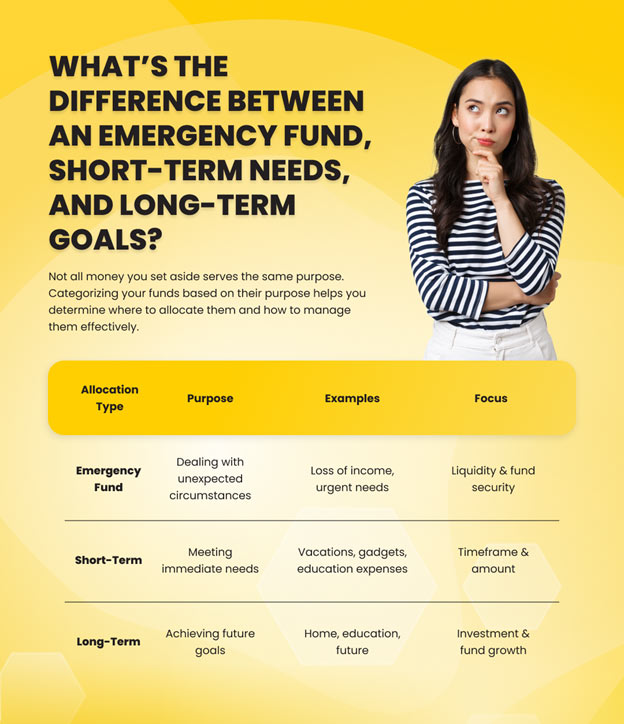
Emergency Fund
Used for unexpected situations, such as loss of income or urgent needs.
Short-Term Needs
Used for goals to be achieved in the relatively near future, such as a vacation, education expenses, or the purchase of specific items.
Long-Term Goals
Used for goals that take longer to achieve, such as buying a home, saving for education, or planning for the future.
With this allocation, you won’t need to withdraw funds from your long-term investments when you need money for urgent needs.
What Are Some Examples of Salary Allocation Based on Financial Goals?
The allocation amounts may vary depending on your financial situation and goals. Here are a few simple examples
Example 1: Just Starting to Manage Your Finances
Suppose you earn IDR 8 million per month and do not yet have an adequate emergency fund. You can focus your allocations first on routine expenses and building an emergency fund. You can also start allocating a portion of your funds toward financial goals with realistic amounts. Example:
- Routine expenses: IDR 4.8 million
- Installments/obligations: IDR 1.2 million
- Emergency fund: IDR 800,000
- Financial goals/investments: IDR 800,000
- Flexible funds: IDR 400,000
Example 2: Emergency Fund Already Established
If your emergency fund is sufficient and your installments are relatively under control, you can increase the portion allocated to financial goals. For example, with a monthly income of IDR 12 million:
- Monthly expenses: IDR 6 million
- Installments/obligations: IDR 1.8 million
- Financial goals/investments: IDR 2.4 million
- Short-term needs: IDR 1 million
- Flexible funds: IDR 800 ribu
Example 3: Setting a Goal to Buy a House
If you have a goal to buy a house within a few years, you can allocate a larger portion of your income to financial goals by reducing discretionary spending.
For example, with an income of IDR 15 million, you set a monthly savings target of IDR 4 million for a house. Recurring expenses, loan payments, an emergency fund, and other needs are then adjusted so that this goal remains realistic.
This example is merely an illustration. The appropriate allocation of your salary still depends on your individual circumstances, obligations, and financial goals.
How Can You Allocate Your Salary So It Isn’t Spent?
One approach you can take is to set aside funds for financial goals at the beginning of the month, rather than waiting until the end of the month.
After receiving your salary, you can immediately divide the funds according to predetermined categories. That way, the money for your financial goals won’t get mixed up with the funds used for daily expenses.
For investments, an automatic debit system can also help maintain consistency. Investment funds will be allocated automatically according to a predetermined schedule, so you won’t need to make manual deposits every month.
How to Plan Financial Goals on the M2U ID App?
To help you plan your finances more effectively, you can use the 360 Digital Wealth – Manage Your Financial Plan (Goal-Based Investing) feature on the M2U ID App, Maybank Indonesia’s mobile banking app. This feature is designed to help you create a more structured plan, run simulations, and get product recommendations to make your dreams come true.
Some of the feature’s key benefits that can assist with planning include:
-
Set Your Own Goals
You can set your own financial goals based on your needs and dreams, such as vacation funds, emergency funds, buying property, or other objectives.
-
Get Simulations and Automatic Calculations
After setting your goals, this feature provides simulations and automatic calculations estimating the amount you need to set aside regularly to achieve those goals.
-
Find Product Recommendations Based on Your Risk Profile
For goals that require investment, you can find recommendations for products that align with your goals and risk profile (such as mutual funds or other investment instruments) from a wide range of available investment options.
-
Achieve Your Goals with Automatic Debit Investments
Investment allocations can be executed automatically through the monthly automatic debit feature. This makes it easy for you to invest consistently and disciplinedly without the hassle of making manual deposits every month.
When Should You Reevaluate Your Budget Allocation?
A budget isn’t something you set once and stick with forever. Periodic reevaluation is necessary when your financial situation or goals change.
Some situations that may warrant reevaluating your allocation include
- Changes in income
- Increases or decreases in loan payments or other obligations
- Your emergency fund has reached its target
- You have new financial goals
- The timeframe for your goals has changed
- Changes in investment value or market conditions
- You’ve achieved your financial goals
You can conduct an evaluation every few months to see if the amount of funds allocated still aligns with your financial capacity and the progress of your financial goals.
Start with a Realistic Salary Allocation
There’s no one size fits all formula for allocating your salary. The most important thing is to understand your own financial situation, set priorities, and establish achievable goals.
Instead of simply setting aside whatever money is left at the end of the month, decide from the start how much to allocate for routine expenses, an emergency fund, short-term needs, as well as financial goals and investments.
To help you create a more focused plan, you can use use 360 Digital Wealth – Manage Your Financial Plan on the M2U ID App With this feature, you can set your own goals, get simulations and automatic calculations, choose investment products based on your risk profile, and conveniently set up monthly automatic debit investments.
With careful planning and regular reviews, every part of your paycheck can serve a clearer purpose. Let’s start achieving your financial goals through the M2U ID App now!
360 Digital Wealth – Manage Your Financial Plan
Download M2U ID

SHARIA
Halal Indo Expo 2026
Muslim Life Fest 2026
Muslim Pro
Pendampingan Sertifikasi Halal
Islamic Banking as a Service (iBaaS)
Sukuk Investment
Sharia Mutual Fund
Shariah Wealth Management
Simpanan Syariah
Shariah Promotion Program
Hajj and Umrah
Zakat, Infaq & Sadaqah
Sharia Business
Property Financing iB
Instant Financing iB
Car Financing iB
Motorcycle Financing iB
Profit Sharing
Shariah Leaders Forum
OTHERS
Customer Support
Japan Desk
KPR Maybank Payroll
Promotion
Customer Support
Visit Malaysia
News & Announcements
KPM Privilege
Locate Us
Refer a Friend
Fees & Charges
Rates Information
Maybank Basic Credit Interest Rate
Customer Education
External Link
Security Privacy and Policy
Social Media Community Guidelines



Corporate Online Services